
Nixon’s war on the media and the supposed crisis of masculinity in post-WWII America
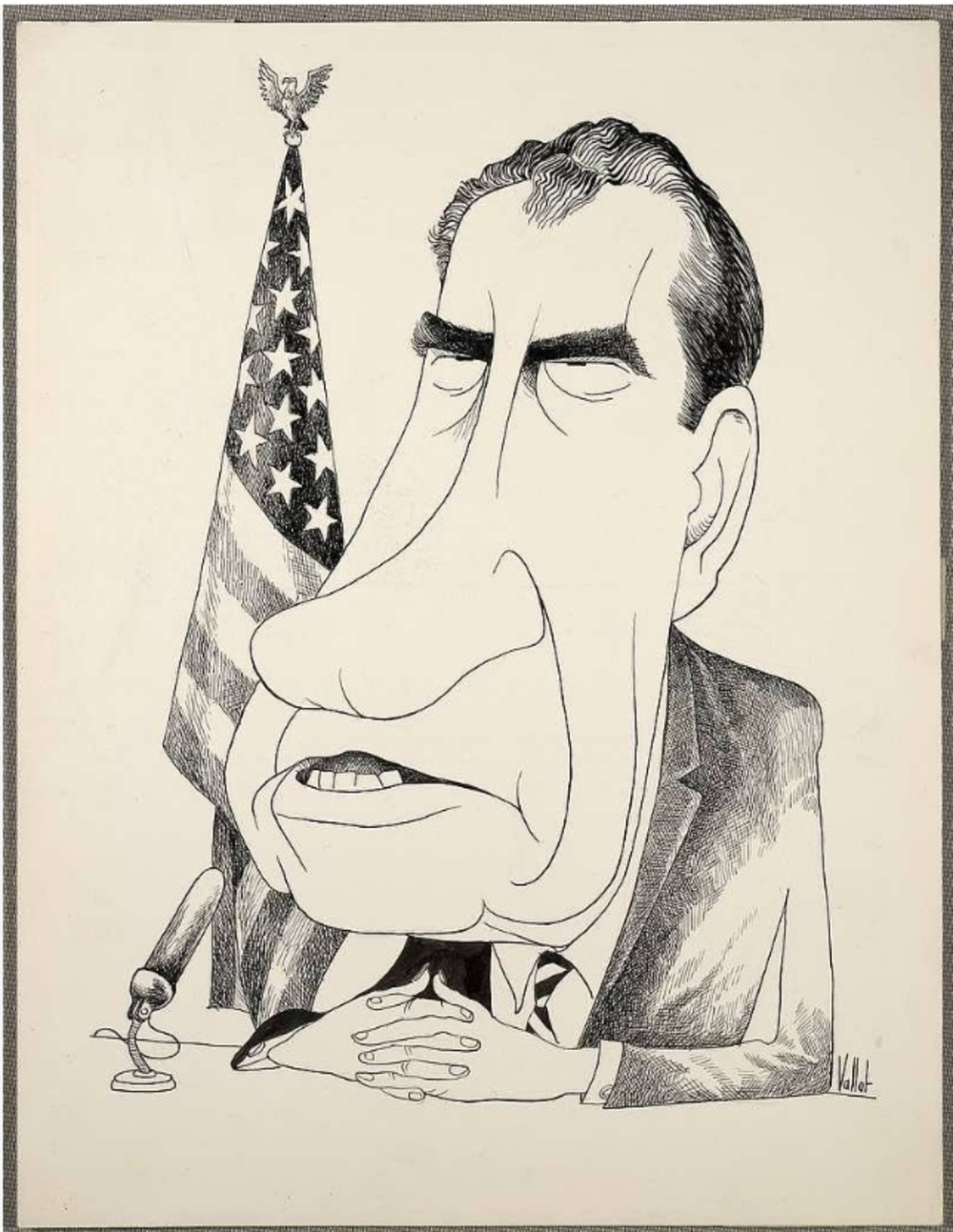
Nixon - drawing. Public domain image from https://loc.getarchive.net/media/nixon-c8b0ae
In recent years, there has been a lot of discourse around the idea of a “liberal media”, untrustworthy technologies and distrust around the press. At first, this can seem like a 21st-century phenomenon spurred by social media and the nonstop interconnectivity of the internet. However, my undergraduate dissertation sought to recontextualise this discussion over a longer durée. Researching Nixon’s tenuous relationship with the press allows us to understand the emergence of a conservative counterculture which opposes news establishments to garner legitimacy. Observing these dynamics from a masculinity lens, we can observe how marginalised identities and communities are constructed as a threat to the American nationalist fabric – perpetuating ‘Us vs Them’ ideology. This “liberal media” bias, often used by populist politicians to delegitimise the press and left-leaning opponents, matters for numerous reasons, including how we synonymise left politics, women, immigrants, and homoeroticism with subversiveness and anti-nationalist sentiments.
Observing magazines, articles, and newspapers allows us to understand how a perceived crisis of masculinity emerged and informed political decisions and media rhetoric. Masculinity became a social concern in post-World War II America, the starting point of my dissertation. When a social identity is in ‘crisis’, this informs public opinion, policy and political strategies; it is a new social concern and instability. From out of this ‘crisis’, politicians gain a space in which to position themselves as the voice reasserting stability. The gender identity crisis reflects issues of national values; what is considered a man in America? Who is excluded from this? Which establishments are seen as contributors to the crisis? The connotation of specific parts of society as subversive and effete excludes marginalised identities from policymaking and discourse. Over a long historical period, the Republican Party has successfully asserted itself as the sound response of social stability by attempting to assert a homogenous society of the white, middle-class, American-born man as the right type of masculinity. Political actors, up to the present day, use the crisis of masculinity (redefined as ‘inceldom’) to mobilise or stoke support.
Richard Nixon’s political career offers a substantial case study through which to substantiate this claim. My research observes how the social phenomenon developed in Nixon as a politician and within media representations of him, but also how this affected his relationship with the media. By categorising the media as an effete, left-wing establishment seeking to disrupt social order, his political performance became a performance of masculinity.
In my research, I used a series of primary sources, including newspapers from the ‘Eastern establishment’ (Washington Post, New York Times), magazine clippings (Look, Esquire), books published by social commentators, political posters, Whitehouse tapes, and interviews (CBS, NBC). These sources work together to understand the emergence of a crisis of masculinity and how it manifested within Nixon. My research spans from 1945 to 1971, examining how Nixon successfully weaponised the so-called crisis of masculinity in America to outcast political opponents in his early career. Nixon synonymised his manhood with a type of masculinity that dominated the national image of America: white, educated, veteran, middle-class. This strategy took a turn when he went against John F. Kennedy for President, despite being more experienced. As theories of masculinity imply, different types of manhood compete for dominance, and when Kennedy emerged on the political scene, there was a swing back in the 1960s to appreciate a younger, more dynamic, elite leader. To attribute blame for this swing, Nixon scapegoated the eastern establishments, promulgating a belief that the media was in control of political outcomes in a democratic society that was intentionally ostracising Nixon’s masculine identity and other conservative men alike.
My research compares Nixon’s political strategies across different decades to understand which performances of masculinity socially resonated and the wider reasons for this. When was the transition from a militarised masculinity to an elite masculinity, and how did Nixon utilise a pendulum swing back to a militarised masculinity under the illusion of ‘restoring order’? This research helps us understand the emergence of a conservative counterculture and right-wing political strategy to further marginalise other identities under the illusion of stability. Within this strategy, Nixon and his inner circles in the White House successfully categorised the press as an effete, liberal, inherent enemy of ‘Law & Order’ (his second Presidential campaign slogan). After successfully winning one of the most powerful positions in the United States, Nixon was emboldened by his homosocial inner circle to further scapegoat the press’s role as a fourth branch of democracy, criticising the executive.
Nixon and his inner circle represented a masculinity that felt threatened by the emergence of a critical press. While reporting the anti-war movements, race riots, civil rights movement and feminist movements, it served the Republican Party best to typecast the media as subverting tradition. I believe the inner circle to be important to research, as it shows how the fragility of gender identity spiralled into paranoia and conspiracy within the White House. It also reasserts that the executive does not exist within a vacuum, but rather is also influenced by other men. For example, I analysed Nixon’s Vice President Spiro Agnew’s speeches, dissecting them to show exactly how categorising the press was executed.
Why does this history matter? Being able to recognise the signposting of anti-establishment sentiments in the press gives more awareness to populist rhetoric, which blames the media for bigger social issues. This is important as the cyclical nature of the conservative counterculture is highly pertinent to our voting and media literacy today. I seek to educate and understand cycles of populism and right-wing rhetoric, and to provide an educational tool to identify these tactics in current politics.
Author Bio:
Ruweyda Ahmed is a recent graduate from the University of Edinburgh. This dissertation was part of her History (MA) Hons degree.