
Unruly Abortions: Between Refusal and Prefiguration
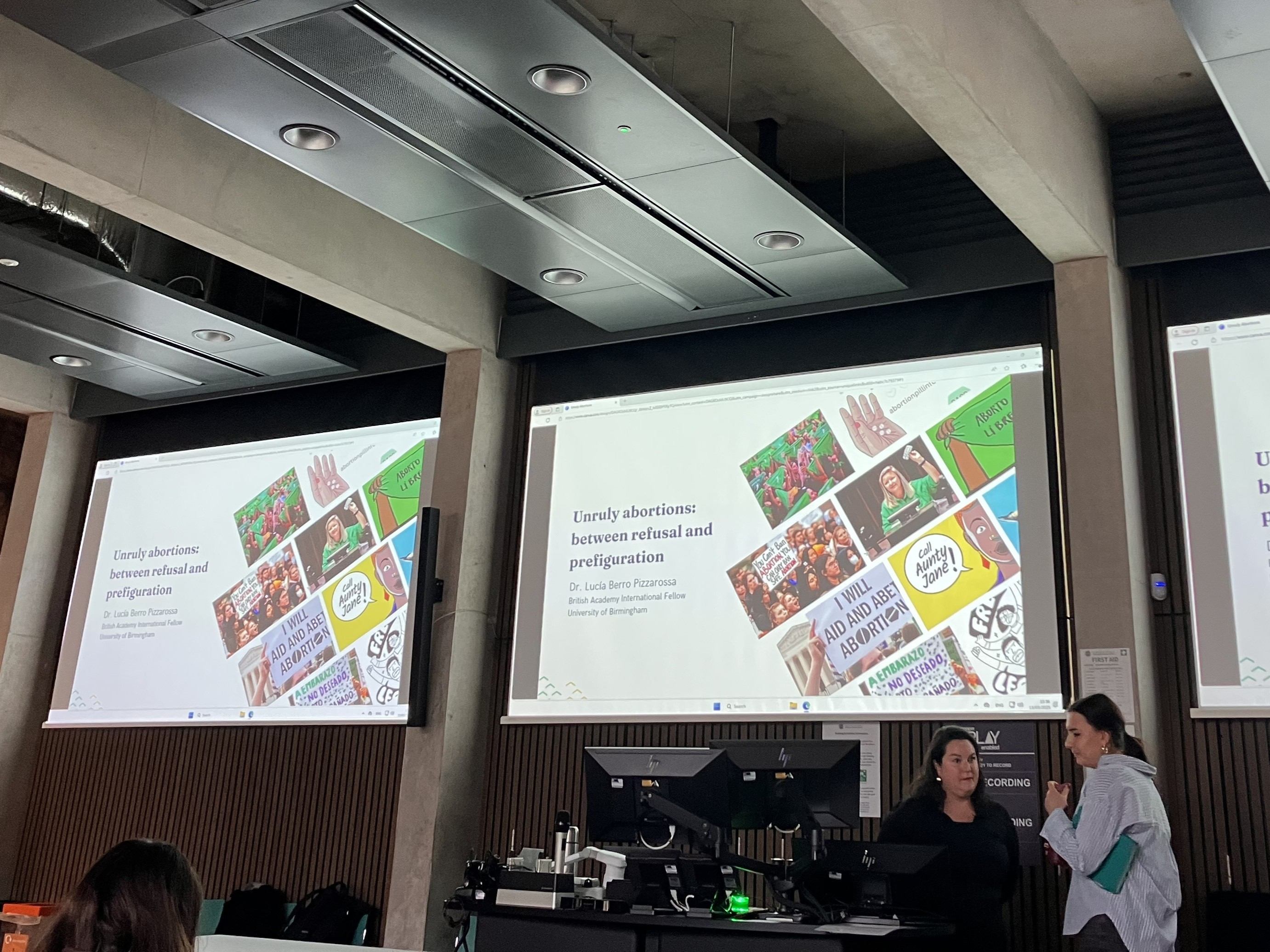
In the second of two blogs about the Reproductive Justice network of the Edinburgh Centre for Medical Anthropology, GENDER.ED’s Undergraduate Intern, Mouna Chatt reflects on a seminar by Lucía Berro Pizzarossa from the University of Birmingham, exploring self-managed abortion collectives and activists.
Pizzarossa began by outlining the history of self-managed abortions (SMAs) through pills. She showed that activists in Brazil started experimenting with misoprostol, a medication against stomach ulcers, in the late 1980s after noticing a warning that the pill should not be taken if pregnant. Now, Pizzarossa showed, misoprostol is recognised as a safe abortion pill.
Pizzarossa showed how SMAs through pills have always been driven by activists on the ground. The drug has been given meaning through activist work, rather than vice versa. This process belies the assumed medico-legal emphasis on the ‘self’ as an autonomous being, who can carry out the abortion. Rather, Pizzarossa and her colleague add the idea of the ‘constellation of actors’. Essentially, activists are experimenting with dissemination of information about misoprostol and simultaneously communicating with one another. A whole group of people needs to exist to enable a safe SMA, and therefore, Pizzarossa argued, SMA is a political project.
Decentring legality
Pizzarossa then outlined how SMA collectives work to decentre the ‘legal’. Essentially, when a person needs an abortion, they go to SMA collectives, who provide them with the medication and support them in having a safe abortion. SMA collectives argue that legality must be decentred, for, there are things that come before the law. They highlight that while abortion can be legal or illegal, if a person needs an abortion now, activists will have to show up now. They add that the law is a social construct, which responds to the social norms of the time, so it will never sufficiently meet the needs of all people. This is a transformative way of thinking about abortion, which has always been discussed through the lens of legality.
SMA collectives and activists argue that abortion matters in terms of human rights, justice, and dignity – not the law. They add that women ‘overflow’ the laws. Thus, SMA is a refusal of the law. The law is not a measure of what is possible. Drawing on a quote from one of her interlocutors, Pizzarossa highlighted, “The law is as powerful as we are compliant”. Pizzarossa introduced the interesting idea that SMA collectives are “tickling the law”. Essentially, in the ways that collectives speak about it, they play with the idea of selectively using the law and legal language to obtain their goals. For instance, a collective in Ireland used legal language of ‘referenda’, expressing, “[t]he only referendum you can have around abortion is in your own bathroom when you see a pregnancy test”. Similarly, Spanish-speaking SMA collectives often play with words that use ‘miso’ (short for misoprostol) and ‘permiso’ (permission).
Thus, Pizzarossa demonstrated that SMA collectives or activists are highly political. She highlighted that sometimes they work within the law, but often they refuse or push back against it, with some collectives being more explicit about their intentions than others.
Aunties and Companions
Interestingly, Pizzarossa found that the names of SMA collectives in Poland, Germany, Czechia, Cameroon, the Democratic Republic of Congo, and Kenya often included the word ‘aunt’. In Latin America, the names of SMA collectives often include words linked to ‘friendship’ and ‘companionship’. Thus, SMA collectives often make reference to ‘another person’, who can support you through the abortion process; a person unaffiliated with the medical sphere.
This naming also ruptures the assumption that abortion is something that must happen in isolation. Instead, SMA collectives highlight that abortion is a collective experience. The ways in which it is collective, however, differs on the needs of the individual having the abortion. Pizzarossa showed that it can entail something as simple as someone doing the groceries or sorting out childcare for you, so that you can carry out the abortion in a safe way. She added that SMA collectives have a broad and holistic understanding of safety. They are not only concerned with the ‘physical safety’ of the abortion, but also what is most safe under the law.
Pizzarossa added that SMA collectives’ emphasis on decentring legality also extends to decentring laws that demarcate borders. SMA collectives consider themselves to be part of a transnational movement of transboundary care. Thus, they commit to an abolitionist goal of erasing borders to make sure that people can receive healthy, safe abortions across the globe.
The lecture was followed by an interesting and engaging Q&A session with the audience. A member of the audience asked about how ‘useful’ it is to ‘tickle the law’. Pizzarossa presented the idea that SMA’s effectively push back against the monopoly of interpretation of laws that exist in society. Thus, they operate in an ambivalent position. While the ‘play around’ with the law and legal language, they are simultaneously very aware of its boundaries.
Thank you to the Reproductive Justice network of EdCMA for organising the talk!
You can read more about Dr. Lucía Berro Pizzarossa work here.