
Women’s Liberation 50 Years On: Demanding Legal and Financial Independence - 3
This is the third of a series of three posts written to mark the 50th anniversary of the Women’s Liberation Movement (WLM) Conference in Edinburgh, and to connect the history of feminist activism with campaigning now. This is part of a larger project in which GENDER.ED and the Institute for Advanced Studies in the Humanities (IASH), at the University of Edinburgh, are partnering with Women’s History Scotland (WHS) and James Gillespie’s High School, where the conference was held 28-30 June 1974. In this post Amy Life interviews women who were involved in the Women’s Liberation Movement, hearing from them their memories of the conferences, their insights into the 5th demand and why it was important, and their observations about how far we have come and what still needs to be done.
In 1974 the UK Women’s Liberation Movement (WLM) held its national conference in Edinburgh, with a key outcome the adoption of two ‘new’ demands for:
- legal and financial independence for all women;
- the right to a self-defined sexuality, including an end to discrimination against lesbians.
These 5th and 6th demands were added to four existing ones (set out at the first national conference at Ruskin College, Oxford in 1970) for:
- equal pay;
- equal educational and job opportunities;
- free contraception and abortion on demand;
- free 24-hour nurseries for children.
The Women’s Liberation Movement has had a lasting impact not only on the lives young women are now able to lead but also on the women who were involved in campaigns around the country, and the world. Their stories are at the heart of the fight for gender equality, and it has been both moving and enlightening to hear these stories first-hand. I was honoured to speak to Esther Breitenbach, Ruth Lister and Sheila Gilmore about their experiences campaigning in the Women’s Liberation Movement, their work relating to the 5th demand and their thoughts on feminist activism today.
All three women campaigned around the 5th demand on legal and financial independence, and it was some of the issues that the demand aimed to address that encouraged them to join the movement. Esther Breitenbach joined the Dundee Women’s Liberation Group and the Legal and Financial Independence Campaign, Ruth Lister became involved with the 5th Demand group, and Sheila Gilmore was part of the Edinburgh Women’s Liberation Group and the Legal and Financial Independence campaign, and they were all a part of various other groups as well – a testimony to the range of organising that was happening in the 70’s.
Speaking about becoming involved in with the 5th Demand group, Ruth Lister says that for her, “it was very much a question of financial and legal independence and particularly financial independence. And so, the group was ideal for me as something to get involved in”.
When I ask about attending Women’s Liberation Conferences and what it was like to attend them, Esther tells me about the formats of the conferences and how they fostered meaningful exchanges between women:
“The formats of the conferences were similar, there was a mixture of big plenary sessions, so everybody who was at the conference came together and then workshop sessions. The idea of the workshop is focussed discussion in a smaller group. And I think that that was very stimulating: you could choose which ones to go to.” She adds, “In my point of view what the conferences did was provide opportunities for what we’d call networking nowadays and introduced you to ideas and campaigns”.
Sheila Gilmore gives me a similar picture of the conferences explaining that they gave “the opportunity to have those talks, have those discussions and have a bit of fun as well.” She describes them as being “the sort of event where if somebody wanted to start having a discussion, they might just announce it was happening. Which might have ended up going nowhere in particular, or it might be the beginning of something in the future. It’s quite hard to describe in that sense because it flowed more than what most people would understand of a conference.” She also describes the plenary sessions as being ‘probably quite chaotic, but chaotic in a good way.”
Ruth and Esther both spoke of the conflicts that arose during conferences, telling me that some disputes could get quite heated. Esther tells me that during the plenary session at the Edinburgh conference, there was an argument concerning the Imperial Typewriter’s Strike and Ruth describes the difficulties of resolving conflicts at a later conference in Birmingham.
Speaking about the conflicts, Esther says, “I think initially there was that sort of sense of euphoria surrounding the idea of sisterhood as powerful and I think when arguments emerged that were quite heated, that some women were very dismayed and disconcerted by that, but it’s a fact of political life.”
I asked all three women about the importance of the 5th demand both in the UK and in the Scottish context.
Speaking about the demand more broadly, Ruth says “I think its importance came out of the way women were treated by tax and social security systems at that point”
Out of the 5th Demand campaign, Ruth and other members of the group set up another campaign called ‘YBA Wife’ (why be a wife, see image below).
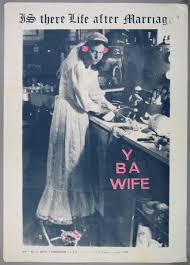
Image: BA Wife poster, See Red Women’s Workshop, 20th Century, Glasgow Women's Library.
Ruth tells me that they received ‘an amazing response’ and received a huge amount of post back from women around the country. She says to me “it was sad because it clearly tapped into a nerve among many women who felt trapped in marriages where they didn’t have legal personhood and it wasn’t a good thing for them.”
She also tells me that the lack of resources made campaigning incredibly hard work that involved a lot of manual labour. She says “it was such a shame because if we’d had the resources, it could have been a big campaign, raising questions about how women were treated in marriage back in the 1970s.”
Speaking about the demand in the Scottish context, both Esther and Sheila tell me about the way Scottish women’s group had to navigate debates around Scotland’s political devolution whilst campaigning for social change.
For Sheila, because a lot of legislation relating to the 5th demand in Scotland would still need to go through Westminster, “there was a need to make sure women’s interests in that were really followed through”.
Speaking of the demand’s importance for women at the time she says “There was an awful lot that had not happened at that stage. Even in basic things like women being able to get mortgages or how the banks would deal with single women, but some married women as well. Your income might not be taken into account, you weren’t really counted as having any sort of status. So that was a part of it, the slightly more financial side of things. But also, we were still at the point where quite a lot of things like marriage, divorce, separation law was needing to be reformed but hadn’t been reformed.”
Speaking about the 5th demand in the Scottish context, Esther tells me that “In Scotland there were groups in Glasgow and Edinburgh. And the formation of groups of Scotland was very much about, in my view, working in a particular institutional environment where there was administrative devolution before there was political devolution.” and adds that “the two groups organised around the campaign for devolution in the 1970s.”
Esther also tells me that “the essential theme of the demand was the state and how the law constructed women as men’s dependents. And so, the idea was to challenge the way in which women were constructed as men’s dependents. And not just conceptually but materially how that affected women. So, you can see it played out through taxation, social security benefits, housing as well... this led to campaigns for legislative change, informing women of their rights, pay, sex discrimination, housing, divorce and custody issues, benefits and so on.”
I also wanted ask Esther, Ruth and Sheila’s opinions about where we are as women today, and what activism looks like now in comparison to the Women’s Liberation Movement of the seventies.
Sheila tells me she’s “not one who says nothing’s changed. I don’t think that’s true, and I think if some of those who say that were transported back to 1974, they’d be quite taken aback, I think.” though she adds that “Violence against women is one area where we appear to have in some ways made so little progress and, in some respects, if feels sometimes as if we’re going backwards”. She says that in response to increasingly misogynistic attitudes among the younger generation,“you’ve always got to be alert, you’ve got to be ready to fight the fight all over again that you thought you’d won.”
Similarly, Ruth tells me that she thinks “the question of women’s economic independence hasn’t gone away altogether; we’ve always got to guard against going backward.” She also says, “my sense is that we were much more of a movement then. You know, the big conferences, it felt more radical, more challenging of the status quo.”
Esther highlights that “one of the things that clearly has changed is social media and how people communicate, and t how that might affect how people act collectively. I think one of the things that is important to say about the 1970s is that all of these conferences and events were very energising, brought women together in contact with new ideas, with each other, allowed the formation of groups and networks”
Understanding the history of feminist movements, such as the Women’s Liberation Movement and the campaign for legal and financial independence that arose, in part, from the adoption of the 5th demand at the Edinburgh conference can help us understand how to continue the work of achieving gender equality. It’s important to understand the strengths of past campaigns and what weaknesses we can learn from. Certainly, it’s clear that women today owe much to the efforts of the movement for financial and legal independence of the 70’s.
Author Bios
Dr Esther Breitenbach is Honorary Fellow in the School of History, Classics & Archaeology, University of Edinburgh; she worked in the Scottish Executive Equality Unit (1998-2001) and the Women and Equality Unit, Department of Trade and Industry (2001-2003). Sheila Gilmore was Member of Parliament (MP) (Labour) for Edinburgh East 2010-2015. Baroness Ruth Lister is a member of the House of Lords and Emeritus Professor of Social Policy at the University of Leicester.
Amy Life is has just completed her degree in French and Philosophy. She has been an Undergraduate Communications Intern for GENDER.ED and President of Edinburgh University’s Feminist Society. She was one of the founders of #MeToo Edinburgh University.